![[Home]](/graphics/2020-02_logo.png)
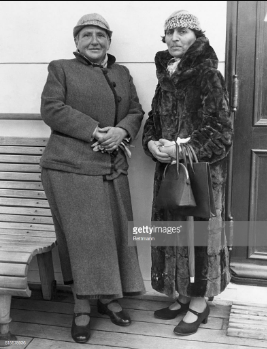 Writer Gertrude Stein and her partner, Alice B. Toklas, arrive in New York City on October 24, 1934.
There are no hard and fast rules about how to write a biography for the Encyclopedia; on this page you'll find some guidelines.
First of all, the Encyclopedia is a work-in-progress and contains mistrakes. When you see mistrakes, from grammar to formatting to factual, please fix or report them. Except infentional mistales, which e.g. RegGiles' Peanut Butter And Jam Sandwich story cycle is packed with.
You are writing for a queer audience in the present and for dozens or hundreds of years in the future. The core context is, How was this person important to the LGBT2QS* community in Nova Scotia? What did they do? Your biography must answer that.
If you're composing in a word processor, don't bother with a lot of fancy formatting.
GaryKinsman writes: I usually think it is best to construct biographies around some major contributions a person has made. Once that is there then other details can be filled in. If I can be of any assistance let me know.
Dave Stewart in Charlottetown, writes: Daniel, I think it also depends on what length of bio you're talking about, and where it's going to appear (online, book, etc.). If it's longer than a paragraph, I'm a fan of writing it as a sort of story (Honestly, this can be done even if it is a paragraph). If there's a great quote or fact about the person, and there's opportunity to include it, I sometimes like to use that as a way in/magnet to attract people to the bio, and give them a sense of what it is about the person that makes them someone to read about. If it's a bio of a living person, I like to give the reader a sense of that person's future. In the end, there are a thousand ways to write a bio, however, and none of them are wrong.
Often the easiest way to get bio information from a subject is via a face to face talk. If you do this,
There's a fairly complete list here: HistoryProjectInterview.
Here's a basic guide to the sections and one order of storytelling that could work:
Then, the meat of your story: what things your subject was involved with, how they got involved, and who, and when. The "when" part is often very difficult for most people. Footnote factual sources as much as you can.
And... saucy tales! Readers throughout the ages love these. If you can encourage your subject to share some salacious stories, do it up! Keep your ears tuned for, prompt & prod for, anecdotes that illustrate the kind of person they are or were: these bring the person to life.
 This main part of the biography can contain:
Photographs. The usual biography format calls for one or two photographs of the subject. We always need dates, even if approximate, for photographs. If the dates are guesses, mark them with the symbol ca. They can be contemporary or from the early days in the community.
Ask your subject if they have photos of the LGBT community to share. These will need dates and captions, but there is room for them in the Encyclopedia and in the archives.
Similarly ask if the subject has materials that can go into the LGBT archives. This is a separate project but since we're doing history, it makes sense to ask.
Encourage your subject, if they later remember more things they were involved with, or have more information, or find some photographs or other media, to contact you. This is a living document.
This page is in the HowtoCategory